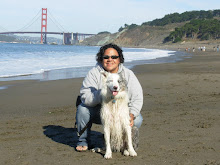
All About Paws Dog Walking, Best of the BayList - CityVoter
Showing posts with label dog walking. Show all posts
Monday, March 29, 2010
Sunday, March 28, 2010
Saturday, January 9, 2010
Even In Recession, Dog Walkers' Hands Are Full
by Josie Holtzman NPR All Things Considered
Looking for a job with no dress code, no cubicle and no office politics? One that, despite a tough economy, still has a lot of pup — uh, pep? The clientele can be a handful, but it's nothing a few treats and a long walk can't satisfy.
It's 10 a.m. in downtown New York and Casey Butcher is ready for work, but he's forgotten his paper. A lot of New Yorkers start the day with the morning paper. For Butcher, though, the newspaper serves a whole different purpose.
He's in the dog-walking business, and his first client of the day is a French bulldog puppy named Mochi who is about to take care of his own business.
"A lot of dog walkers invest in the blue poop bags, but I try to use an AM New York when I can," Butcher says. "I'm a little aware of my carbon footprint — I can go through, like, 20 bags a day."
Butcher works for a company called Club Pet NYC. It's not the most glamorous way start to a day, but even in this economy, poop pays. How much does it pay? That can be a little controversial.
An article in a 2004 issue of the New York Daily News asked people how much they made. A dog walker named Sammy Swale reported about $50,000, prompting some dismayed online responses such as, "I went to grad school for five years for a Ph.D. and I still make less than the dog walker!" Another reader replied, "The dog walker is lying, we make much more than that!"
Butcher agrees, although he won't say how much he makes. "I have a friend who's making $100,000, and that's with the company taking half. So he brings in about $200,000 a year just walking dogs." That would be a pretty good income even with Manhattan's high cost of living.
But not just anyone is cut out for this line of work. According to the walkers, it's a lot harder than it looks. First, there's the physical toll. Sherman Ewing, the guy who started Club Pet NYC, says his foot grew a size and a half in his first year from walking about 10 miles a day.
Then there are the logistics. Like the keys to 200 apartments.
"What is amazing is I can tell if any are missing just from the sheer weight of it," says Eric Hahn, who has worked for Ewing for the past seven years and considers himself somewhat of an expert walker.
Even so, walking five dogs at a combined weight of 350 pounds can be a little tricky.
"There is a method. People see you with a bunch of dogs and they think it's just random," Hahn says. He explains his system this way: "Whoever is full and has not been emptied yet is on the outside of you — it's a matter of rotation. I need to keep track of who's empty and full because if a dog's about to go and you go into a lobby ... ."
But what makes dog walking truly challenging is that you have to be good with both dogs and people.
"I have people where their kids call me Uncle Eric," Hahn says. "I've had dinner with my clients. It's not like I'm the help, necessarily; it's more like [an] extended member of the family."
The people at Club Pet NYC won't call dog-walking recession-proof. But it certainly will never require a government bailout or a stimulus package. Unlike the banking industry, dog walkers can always count on a high rate of deposit.
Link to story and audible on NPR
Looking for a job with no dress code, no cubicle and no office politics? One that, despite a tough economy, still has a lot of pup — uh, pep? The clientele can be a handful, but it's nothing a few treats and a long walk can't satisfy.
It's 10 a.m. in downtown New York and Casey Butcher is ready for work, but he's forgotten his paper. A lot of New Yorkers start the day with the morning paper. For Butcher, though, the newspaper serves a whole different purpose.
He's in the dog-walking business, and his first client of the day is a French bulldog puppy named Mochi who is about to take care of his own business.
"A lot of dog walkers invest in the blue poop bags, but I try to use an AM New York when I can," Butcher says. "I'm a little aware of my carbon footprint — I can go through, like, 20 bags a day."
Butcher works for a company called Club Pet NYC. It's not the most glamorous way start to a day, but even in this economy, poop pays. How much does it pay? That can be a little controversial.
An article in a 2004 issue of the New York Daily News asked people how much they made. A dog walker named Sammy Swale reported about $50,000, prompting some dismayed online responses such as, "I went to grad school for five years for a Ph.D. and I still make less than the dog walker!" Another reader replied, "The dog walker is lying, we make much more than that!"
Butcher agrees, although he won't say how much he makes. "I have a friend who's making $100,000, and that's with the company taking half. So he brings in about $200,000 a year just walking dogs." That would be a pretty good income even with Manhattan's high cost of living.
But not just anyone is cut out for this line of work. According to the walkers, it's a lot harder than it looks. First, there's the physical toll. Sherman Ewing, the guy who started Club Pet NYC, says his foot grew a size and a half in his first year from walking about 10 miles a day.
Then there are the logistics. Like the keys to 200 apartments.
"What is amazing is I can tell if any are missing just from the sheer weight of it," says Eric Hahn, who has worked for Ewing for the past seven years and considers himself somewhat of an expert walker.
Even so, walking five dogs at a combined weight of 350 pounds can be a little tricky.
"There is a method. People see you with a bunch of dogs and they think it's just random," Hahn says. He explains his system this way: "Whoever is full and has not been emptied yet is on the outside of you — it's a matter of rotation. I need to keep track of who's empty and full because if a dog's about to go and you go into a lobby ... ."
But what makes dog walking truly challenging is that you have to be good with both dogs and people.
"I have people where their kids call me Uncle Eric," Hahn says. "I've had dinner with my clients. It's not like I'm the help, necessarily; it's more like [an] extended member of the family."
The people at Club Pet NYC won't call dog-walking recession-proof. But it certainly will never require a government bailout or a stimulus package. Unlike the banking industry, dog walkers can always count on a high rate of deposit.
Link to story and audible on NPR
Monday, January 4, 2010
Pack of coyotes sparks concern in San Rafael
Jennifer Upshaw Swartz
Posted: 01/03/2010 10:23:56 PM PST
Linda Gattuccio walks her two dogs Sammi and Maggie in San Rafael. Gattuccio has changed her route after encountering a pack of coyotes along a trail behind Embassy Suites. (IJ photo/Robert Tong)
Linda Gattuccio and her two golden retrievers used to enjoy their early-morning walk on the dirt path along the wetlands adjacent to the Marin Lagoon development behind the Embassy Suites hotel in San Rafael.
No more.
It was about eight weeks ago that Gattuccio, 58, an account executive with Fidelity National Title Co. in San Rafael, first spotted the pack of five coyotes on the dirt path popular with dog walkers, exercisers and people pushing strollers.
"I've seen them close to Embassy Suites, around behind Embassy Suites, occasionally one or two, but not really in our neighborhood," she said, adding that she had seen them before near her walking trail behind a big fence but never on the path.
"God, there were five of them on the actual dirt path," she recalled. "They were grouped together. Somebody goes 'act big like a bear and they will run.' They did not run. They stood their ground."
Coyotes have become a fixture in the county, with animal control officials reporting sightings on the rise in the past decade. Encounters have been reported in Hamilton, Terra Linda, China Camp, the Ross Valley, Mill Valley, Tam Valley, Fort Baker and Sausalito, among other places.
In November, a brazen coyote that enjoys frequenting popular gathering spots in Southern Marin generated more than 60 complaints to the Marin Humane Society.
The coyote, which has been spotted behind Best Buy in Marin City and on the bicycle path near the Holiday Inn in Tamalpais Valley, also
Advertisement
has been seen in residential areas such as Bayvista Circle and Donahue Street in Marin City and on Tennessee Valley Road off of Shoreline Highway.
Wildlife experts say coyotes play an important role in the ecosystem, keeping rodents in check and preventing them from feasting on bird eggs. Humane society officials said there is little to fear from the doglike animals; still, people should use common sense.
In the Marin Lagoon area, others have seen them too. One woman with a stroller stood paralyzed in fear after an encounter one day. Gattuccio, seated in her car at the time, said she leaned on her horn to scare the pack away.
"She was just standing their frozen," Gattuccio said of the woman with the baby. "She obviously didn't know what to do."
Al Pasquale, 69, a marketing executive who lives on Lagoon Court, said, boy, do they have coyotes.
"We really do," he said. "I've seen them twice. I saw one about a month ago, two about two weeks ago and they were walking across McInnis just north of the Embassy Suites going into that company Autodesk and they went right in front of my car. They were healthy-looking coyotes."
He said he's not too worried, but does keep a close eye on his small Norfolk terrier when the dog goes out to do business at night.
"I don't want anything killed," he said of the pack. "Just capture them and put them up in the woods or something."
A tricky proposition, said Carrie Harrington, a spokeswoman for the Marin Humane Society. Because coyotes have a wide range, relocation is tough.
Still, residents should call when they spot the pack.
"If they haven't already, definitely call us," she said. "We'll send officers to the area to patrol. We'll post notices in the area. It's not easy to trap and relocate them. They tend to have quite a big radius they travel, so they might come back again, but definitely call us. That sounds like an area that we might want to post notices."
Gattuccio, who now only walks on the concrete path along McInnis Parkway and avoids the isolated dirt trail, said she thought she had a good strategy but has since abandoned it.
"I was going to get a foghorn," she said. "I looked it up in on the Internet. If you make it uncomfortable they'll probably go back up into the hills. My neighbor said, 'if you shoot a foghorn off at 6:30 in the morning we will evict you and keep the coyotes."
Contact Jennifer Upshaw Swartz via e-mail at jupshaw@marinij.com
Jennifer Upshaw Swartz
Posted: 01/03/2010 10:23:56 PM PST
Linda Gattuccio walks her two dogs Sammi and Maggie in San Rafael. Gattuccio has changed her route after encountering a pack of coyotes along a trail behind Embassy Suites. (IJ photo/Robert Tong)
Linda Gattuccio and her two golden retrievers used to enjoy their early-morning walk on the dirt path along the wetlands adjacent to the Marin Lagoon development behind the Embassy Suites hotel in San Rafael.
No more.
It was about eight weeks ago that Gattuccio, 58, an account executive with Fidelity National Title Co. in San Rafael, first spotted the pack of five coyotes on the dirt path popular with dog walkers, exercisers and people pushing strollers.
"I've seen them close to Embassy Suites, around behind Embassy Suites, occasionally one or two, but not really in our neighborhood," she said, adding that she had seen them before near her walking trail behind a big fence but never on the path.
"God, there were five of them on the actual dirt path," she recalled. "They were grouped together. Somebody goes 'act big like a bear and they will run.' They did not run. They stood their ground."
Coyotes have become a fixture in the county, with animal control officials reporting sightings on the rise in the past decade. Encounters have been reported in Hamilton, Terra Linda, China Camp, the Ross Valley, Mill Valley, Tam Valley, Fort Baker and Sausalito, among other places.
In November, a brazen coyote that enjoys frequenting popular gathering spots in Southern Marin generated more than 60 complaints to the Marin Humane Society.
The coyote, which has been spotted behind Best Buy in Marin City and on the bicycle path near the Holiday Inn in Tamalpais Valley, also
Advertisement
has been seen in residential areas such as Bayvista Circle and Donahue Street in Marin City and on Tennessee Valley Road off of Shoreline Highway.
Wildlife experts say coyotes play an important role in the ecosystem, keeping rodents in check and preventing them from feasting on bird eggs. Humane society officials said there is little to fear from the doglike animals; still, people should use common sense.
In the Marin Lagoon area, others have seen them too. One woman with a stroller stood paralyzed in fear after an encounter one day. Gattuccio, seated in her car at the time, said she leaned on her horn to scare the pack away.
"She was just standing their frozen," Gattuccio said of the woman with the baby. "She obviously didn't know what to do."
Al Pasquale, 69, a marketing executive who lives on Lagoon Court, said, boy, do they have coyotes.
"We really do," he said. "I've seen them twice. I saw one about a month ago, two about two weeks ago and they were walking across McInnis just north of the Embassy Suites going into that company Autodesk and they went right in front of my car. They were healthy-looking coyotes."
He said he's not too worried, but does keep a close eye on his small Norfolk terrier when the dog goes out to do business at night.
"I don't want anything killed," he said of the pack. "Just capture them and put them up in the woods or something."
A tricky proposition, said Carrie Harrington, a spokeswoman for the Marin Humane Society. Because coyotes have a wide range, relocation is tough.
Still, residents should call when they spot the pack.
"If they haven't already, definitely call us," she said. "We'll send officers to the area to patrol. We'll post notices in the area. It's not easy to trap and relocate them. They tend to have quite a big radius they travel, so they might come back again, but definitely call us. That sounds like an area that we might want to post notices."
Gattuccio, who now only walks on the concrete path along McInnis Parkway and avoids the isolated dirt trail, said she thought she had a good strategy but has since abandoned it.
"I was going to get a foghorn," she said. "I looked it up in on the Internet. If you make it uncomfortable they'll probably go back up into the hills. My neighbor said, 'if you shoot a foghorn off at 6:30 in the morning we will evict you and keep the coyotes."
Contact Jennifer Upshaw Swartz via e-mail at jupshaw@marinij.com
Subscribe to:
Posts (Atom)